The Socks Come First
Ben Proctor has learned not to lead with a sermon. He leads with socks.
“Socks are the number one thing that people go through,” he says. “I give them socks and water.”
Only after that does he ask the question that has come to define his ministry: How is your relationship with Jesus Christ? And then, gently, the one after that: Do you want to get off the street?
For three and a half years, Proctor and his ministry partner and wife, Deb, have been driving the backroads, wooded encampments, and street corners of the Carolinas, delivering food, water, and hand-packed blessing bags to people living through homelessness. They call it Carolina HOPE — a ministry built not on grand infrastructure, but on a four-person board, a Saturday routine, and a founder who has spent years quietly rethinking what it means to help.
The shift didn’t happen overnight, and it didn’t happen easily.
“I don’t want to call people homeless,” Proctor says. “We call them people experiencing homelessness in this season of their life. They are people first. It’s a terrible thing to have to experience.”
That distinction of people first, circumstance second is more than semantics to Proctor. It’s a discipline he has had to practice deliberately. “I am purposely changing my mindset,” he says. “I’m always learning.”
For most of those three and a half years, the work offered little visible reward. “We did not witness someone go into recovery,” Proctor says plainly. “We did not witness one person wanting to go back to church or accept Jesus Christ. Not one in more than three years.”
The sameness of it wore on him. “I almost quit twice,” he admits, “because you just see the same thing over and over.” One encounter still sticks with him — a man who told him flatly, “I’m my own savior.”
Rather than walk away, however, Proctor changed his approach. He renamed the ministry Carolina HOPE, and with the new name came a new posture, one built around a single, disarming question he now asks everyone he meets on the street: How is this life working out for you?
“I want to acknowledge their dignity,” he says, “but I want them to know I can help.”
The results came almost immediately. “Since we’ve changed the name and my attitude of doing this, the first time we had three people say they want to get off the street and one street salvation,” Proctor says. A street salvation, he explains, is the same moment familiar to anyone who has sat in a church service and heard a pastor ask, If today’s the day you want to surrender your life to Jesus, raise your hand. Proctor asks the same question on a sidewalk instead of a stage. One man told him he didn’t have a relationship with Jesus but wanted one. A member of Proctor’s prayer team prayed with him right there.
“I am preaching,” he says. “I feel it’s a calling. God wants me to do this. My purpose has changed in going and doing this.”
He points to Matthew 25 as the ministry’s guiding text — Jesus’ words about visiting the imprisoned, clothing the naked, feeding the hungry, and the promise that whatever is done for “the least of these” is done for Him. “In today’s America,” Proctor says, “people experiencing homelessness are the least of these.”
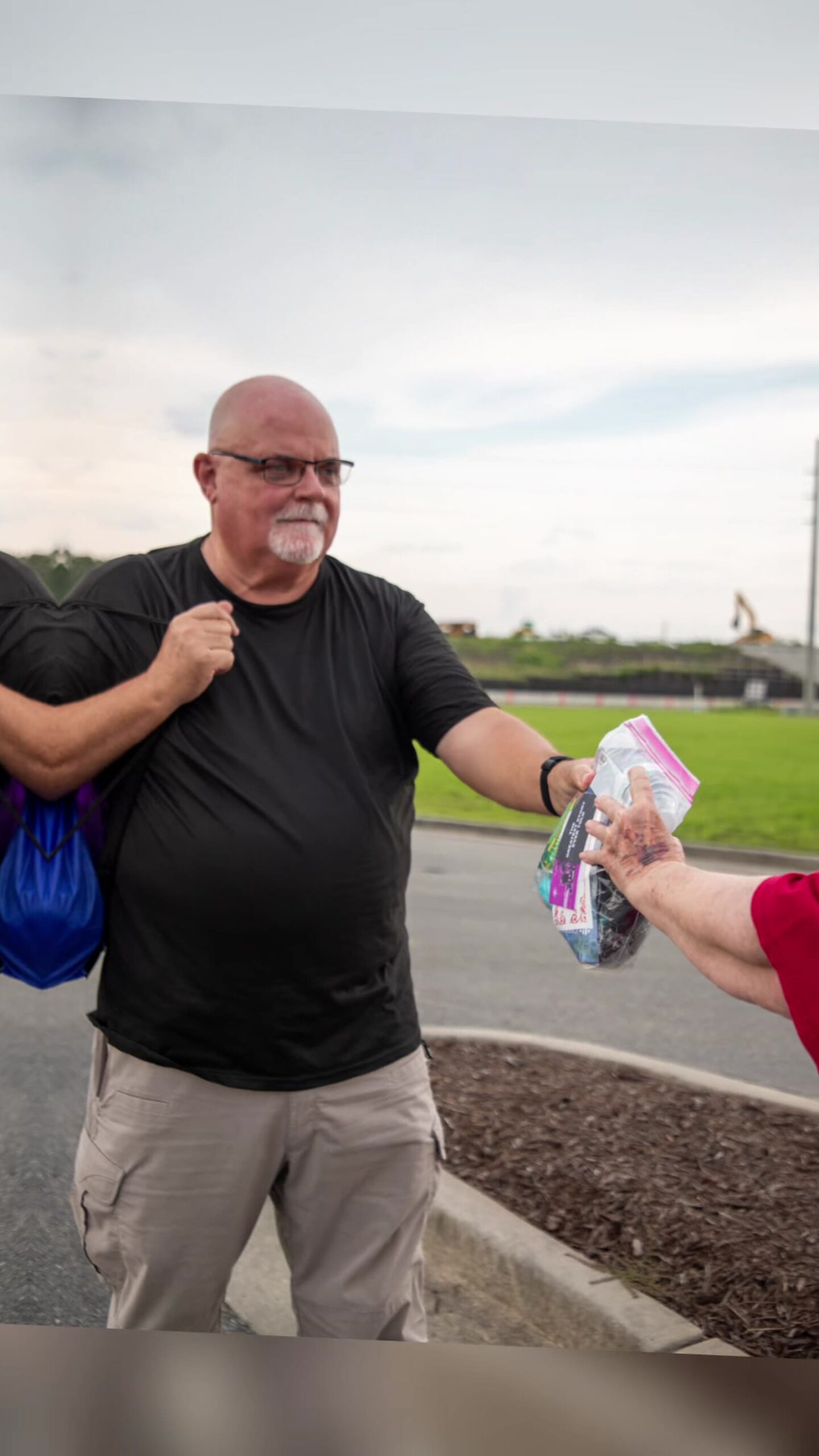
Proctor and his team hand out blessing bags, stocked with the same unglamorous essentials that keep a person alive and dignified through another day outside: new socks, hygiene items, winter stocking caps, emergency blankets, hand warmers in cold months, water bottles, snack items, and phone cards when the budget allows.
It is a small bag carrying a large intention — not the whole solution, but the opening move. A relationship starts with a pair of socks and ends, sometimes, in prayer.
Carolina HOPE’s broader mission is threefold: deliver food, water, and blessing bags directly to people wherever they are, with mothers, children, and families as the first priority; help families facing food insecurity; and serve as a resource guide for a region that, Proctor says, is thinner on services than people assume.
That scarcity is especially acute in Brunswick County, where he lives and works. “There aren’t a lot of resources in Brunswick County because we have so many tourists,” Proctor explains. “They need to be somewhere like temporary housing. Wilmington has that, but it is over full.”
It’s a gap Carolina HOPE’s long-term goal — expanding access to temporary housing across its service area, especially for single mothers with children — is meant to help close.
He credits Donna and Gary Phelps of Brunswick County Street Reach as invaluable partners in that work. He remembers Donna’s first question to him, simply: whether he was still around. He was. He is. “People are getting excited about feeding the homeless,” he says.
Right now, Carolina HOPE goes out once a month. When the Carolinas turn cold, that will become once a week, a deliberate scaling-up timed to the season when hand warmers and emergency blankets become necessities.
Behind the outreach sits a small, growing structure: four board members currently, with a fifth on the way. It is still, by design, a lean operation — one that runs less on overhead and more on obedience, as Proctor puts it.
“Obedience to God. That’s what my personal conviction is,” Proctor says. “I feel that God’s laid this on my heart.”
Three and a half years of showing up, mostly without visible results, could have hardened into cynicism. Instead, Proctor describes something closer to momentum. People now ask him when the team is heading out again. “I’m not burnt out yet,” he says. “I get excited when I go out.”
His advice for anyone wondering how to start, or whether it’s worth it, is not complicated.
“Let’s just be kind.”
Carolina HOPE serves communities across the Carolinas. Volunteers can join Saturday outreach efforts, help pack blessing bags and hygiene kits, or simply pray for the ministry. Gifts of any size — given “only as you feel led by the Lord” — help keep the outreach going. Learn how to partner with us.